Dining Room • Ashjar E1, Ashjar, Al Barari, Dubai, UAE
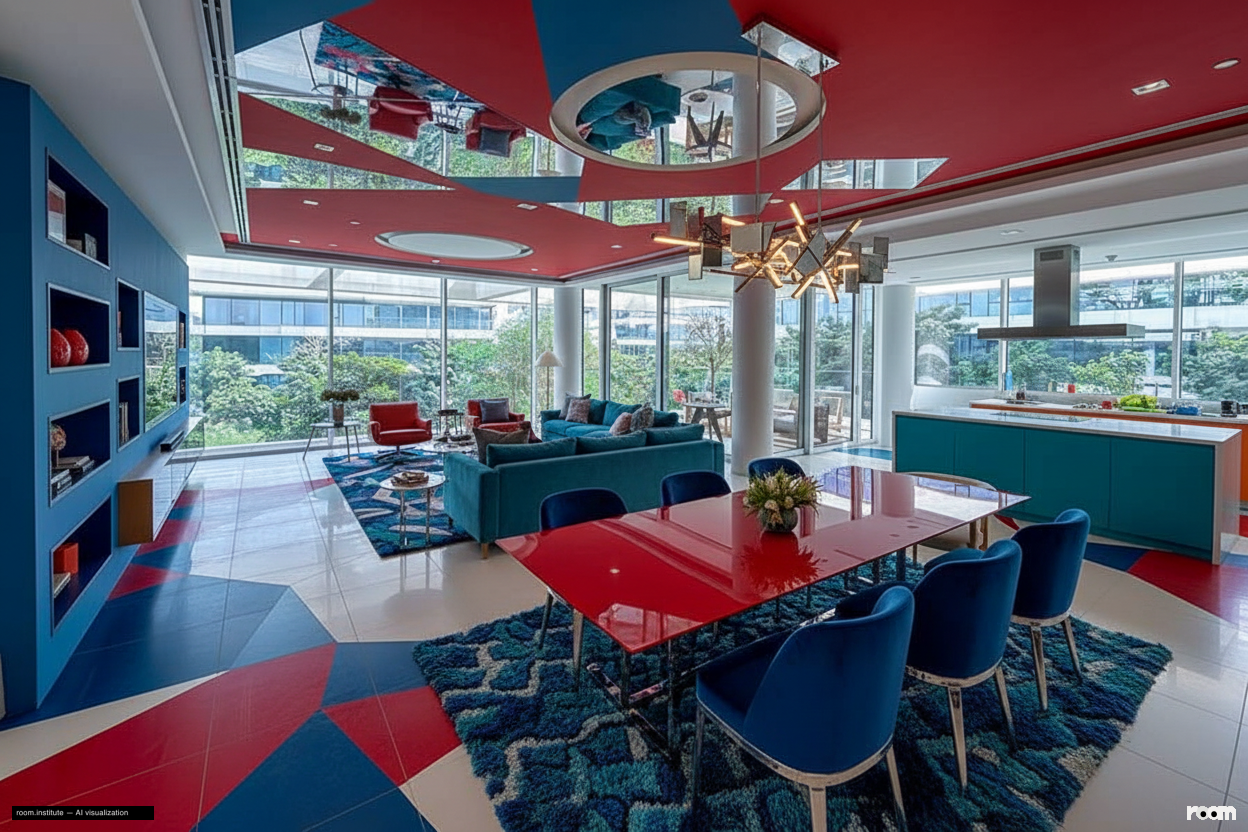
A deep blue wall meets a strong red wall, creating a visual jolt. A vibrant teal kitchen island contrasts sharply with burnt orange cabinets. Geometric floor and ceiling patterns intentionally misalign with furniture layouts. Existing shelving internal surfaces display unexpected color portals.
Dynamic LED strips slowly shift perceived wall colors. Reflective surfaces like a lacquered dining table distort surrounding hues. Furniture pieces in intense colors act as visual punctuation. The entire space presents a new perceptual challenge with each step.
The room constantly asks questions about its true colors.
Design Philosophy
Interrogative Hues explores perceptual boundaries. Color Theory dictates the split complementary scheme. Deconstructivism breaks traditional spatial definitions. This design creates a vibrant yet unsettling visual dialogue.
Spatial Narrative
The eye first fixes on the abrupt wall color shifts. It then traces the misaligned geometric floor patterns. These lines lead the gaze across the expansive open space, constantly questioning zones.
Light Study
Morning sun enters from full-height windows, casting sharp, shifting shadows across the colored surfaces. Dynamic LED lighting activates at dusk. It slowly alters perceived wall colors, continuously redefining the room's edges.
Living Vignette
A person sits on a chrome cantilever chair. They watch the deep blue wall slowly shift to purple under the changing ceiling lights.
Material Palette
High-pigment matte paint: This paint feels smooth and absorbs light; it provides rich, deep color saturation.
Glossy porcelain tiles: Large format, glossy porcelain tiles feel cool underfoot and reflect surrounding colors; they offer high durability.
Lacquered wood: Lacquered wood surfaces feel slick and appear deep; they mirror light and show fingerprints.
Solid velvet upholstery: Deeply saturated velvet upholstery feels soft and visually rich; its pile changes with touch and holds intense color.