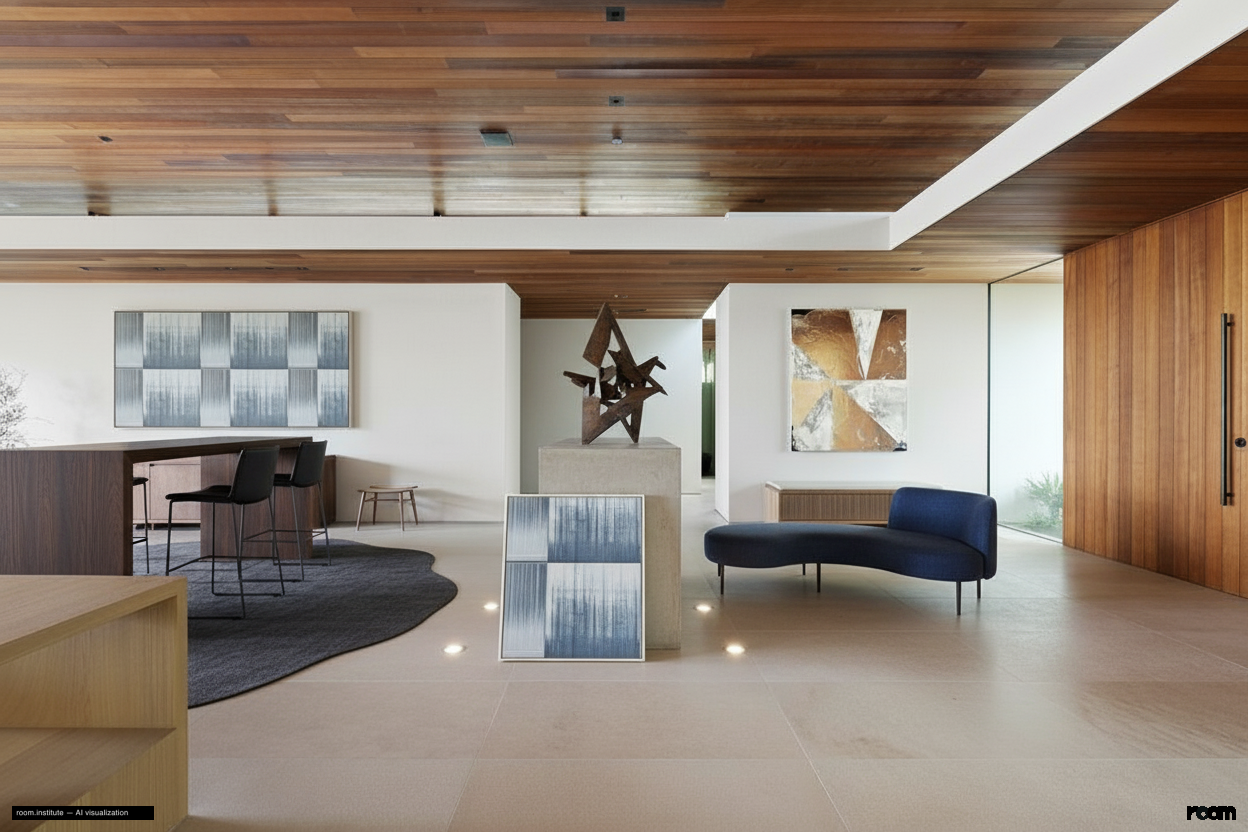
Dining Room • 1675 Carla Rdg, Beverly Hills, CA 90210
The central dining table is replaced by a colossal concrete plinth. A fractured, reflective metal sculpture sits atop it. A sleek, counter-height bar now offers an intimate eating zone. This new bar is crafted from rough-sawn, dark-stained oak.
Uplights cast dramatic shadows, highlighting architectural forms. A low, curvilinear form gently alters the main circulation path. Artworks lean against walls, challenging their display. Raw concrete and polished steel juxtapose with soft felt panels.
This room forces a re-evaluation of expected function.
Design Philosophy
This design disrupts spatial logic. It uses Deconstructivist Arrangement to question utility. Material Juxtaposition forces viewers to re-evaluate common functions. The room challenges assumptions about its purpose.
Spatial Narrative
The eye is drawn immediately to the central concrete plinth and its fractured sculpture. A curvilinear form subtly guides movement around it. You end at the dark-stained oak bar for a closer interaction.
Light Study
Morning light streams through large glass panels, broadly illuminating the expansive space. Evening brings sharp contrasts as focused uplights cast dramatic shadows. Architectural anomalies become pronounced under this artificial glow.
Living Vignette
A guest leans against a wall, observing the fractured metal sculpture from an unexpected angle. Nearby, someone cuts fruit on the dark-stained oak bar surface.
Material Palette
Rough-sawn oak: This dark-stained wood feels textured and ages with a deepening patina.
Polished stainless steel: It reflects light sharply and maintains a pristine, hard surface.
Raw concrete: Its inherent texture is rough to the touch and develops a subtle, varied hue over time.
Acoustic felt panels: These panels feel soft and absorb sound, maintaining their integrity.
Jute: This natural fiber feels coarse and durable, gaining character with use.