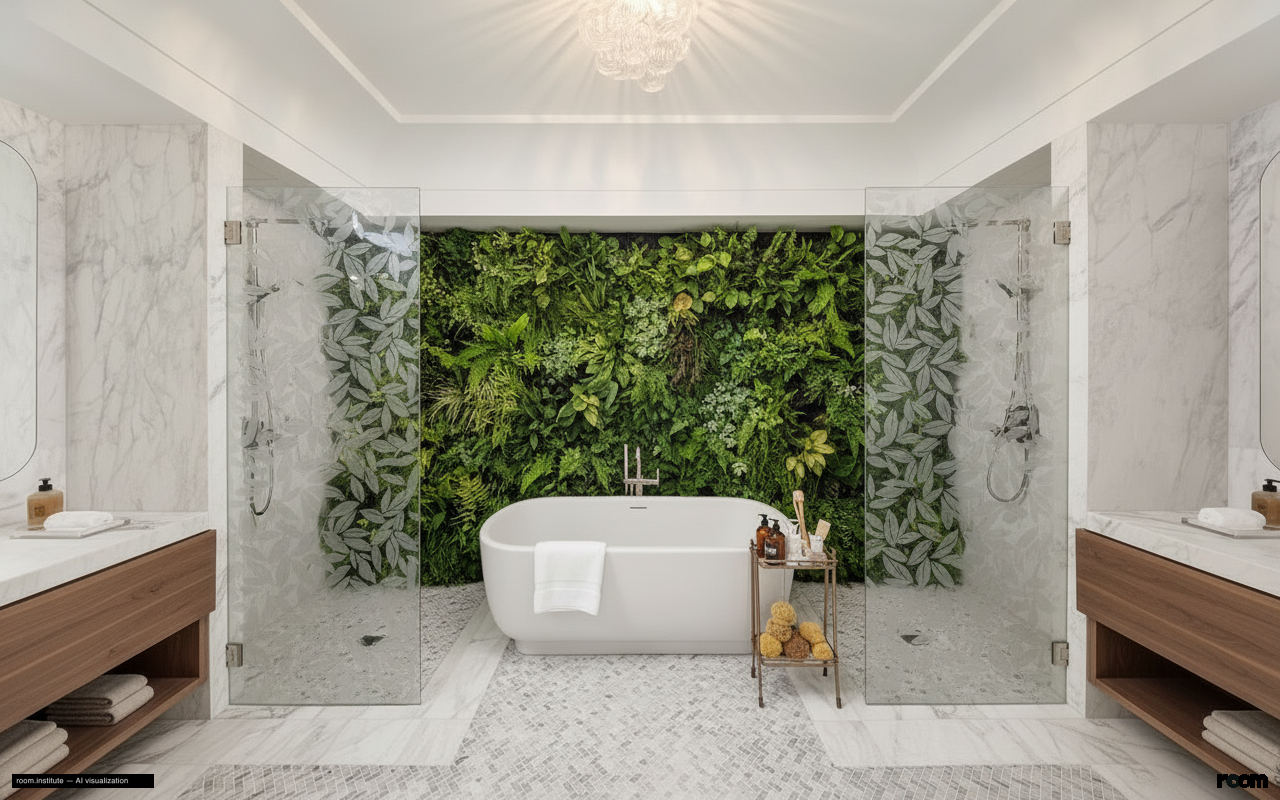
The wall behind the tub now displays a prominent living wall of moss and ferns. Its fractal patterns draw the eye. Tiled floors are replaced by river stone embedded in resin, creating a continuous, textured surface underfoot. Angular vanity edges soften into curved, carved wood units. They provide soft-touch storage. Frosted glass partitions become clear, curved screens, allowing light and views to flow through etched biomorphic patterns.
Overhead lighting uses hidden LED strips, casting dappled, natural-spectrum light. Directional spotlights highlight the living wall, integrating within curved soffits. The room guides movement with gentle, curving circulation paths. Every step connects to natural forms.
This room delivers a direct, sensory connection to natural living systems.
Design Philosophy
The design creates a bathroom deeply connected to nature. It uses organic forms to soften existing angular lines. Sensory layering builds richness through varied textures like moss, stone, and carved wood. Natural-spectrum lighting further enhances this deep connection.
Spatial Narrative
Your eye first lands on the expansive living wall behind the tub. Gentle curves guide your steps around the smooth river stone floor. You settle into the tub, surrounded by dappled light and natural textures.
Light Study
Morning light streams through the window, catching the biomorphic patterns on the glass screens. It highlights the living wall's dew-kissed textures. Evening brings soft, integrated LED light. It mimics dappled sunlight, creating a quiet glow.
Living Vignette
Water runs into the tub, its sound soft against the damp moss wall. Your fingers trace the cool, smooth surface of a river stone underfoot.
Material Palette
Living wall (mosses and ferns): It feels soft and cool. It remains vibrant with proper care.
Resin-embedded river stones: They feel smooth and cool underfoot. They gain a subtle sheen over time.
Solid walnut: It feels warm and dense. It develops a deeper, richer patina with age.