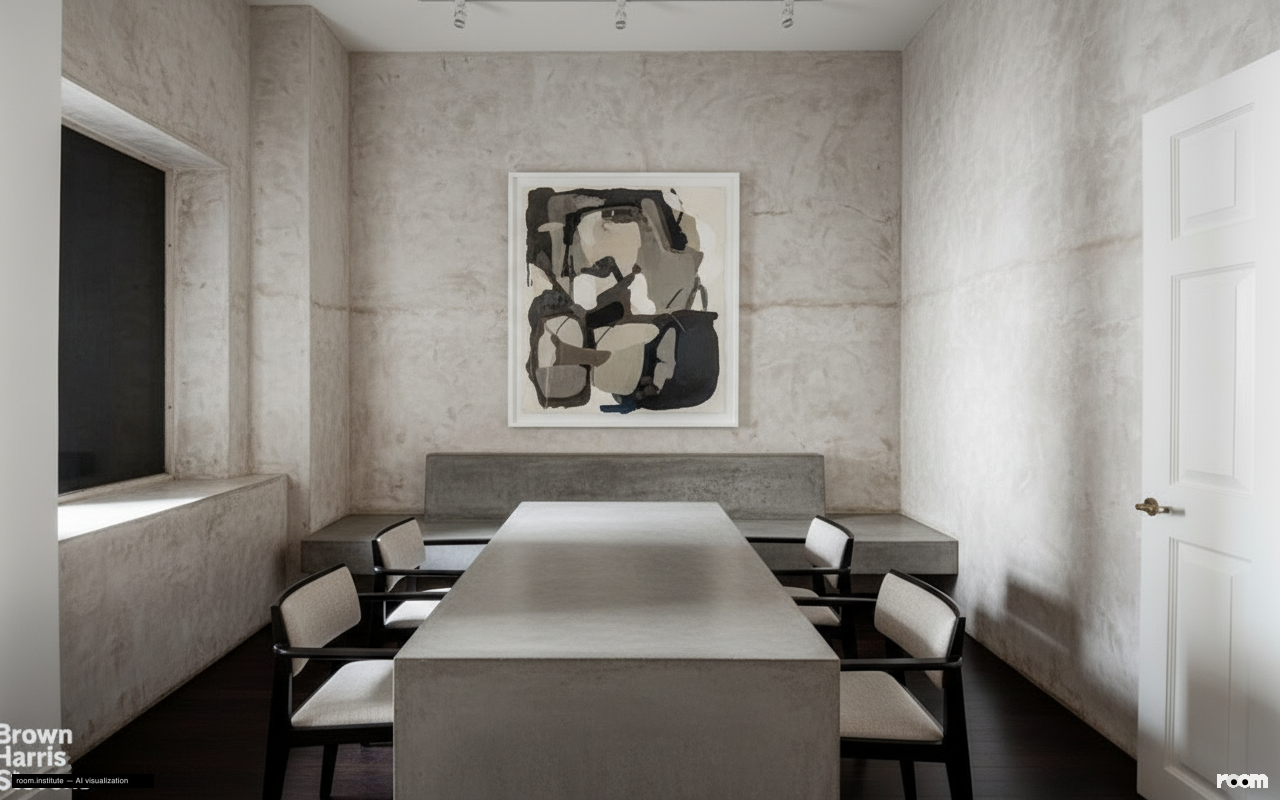
Walls now feature raw plaster. Window casings are removed, revealing structural depth. A single, monolithic concrete bench replaces former art and seating. Track lighting is nearly invisible, highlighting textural details.
The dining table is a solid, unadorned concrete slab. Hardwood flooring is refinished to a deeper, matte tone. A charcoal flatweave rug defines the dining area. The door and frame are flush, matching the plaster finish.
This room distills form to reveal its essential structure.
Design Philosophy
Deconstructive Minimalism guides the approach. Elements are stripped to reveal their essence. Structural Transparency shows raw material layers and wall openings. Every form exists to highlight the room's core identity.
Spatial Narrative
The eye is drawn to the raw window opening, then across the room to the monolithic concrete bench. Movement leads to the unadorned concrete dining table. One sits on natural linen, grounded by the dark floor.
Light Study
Morning light pours through the exposed window opening, revealing the raw plaster's texture directly. As evening arrives, the recessed track lighting casts focused beams. It highlights wall surfaces and sculptural forms, creating deep shadows.
Living Vignette
A hand rests on the cool, unpolished concrete table, tracing its raw surface. The only sound is the subtle shift of fabric as someone sits on the bench.
Material Palette
Raw plaster: Its hand-troweled finish offers subtle texture, gaining character from light and shadow.
Unpolished concrete: The cool, tactile surface absorbs light, developing a worn patina with age.
Darkened brushed steel: Its matte, subtle sheen provides grounding contrast, resisting obvious wear.