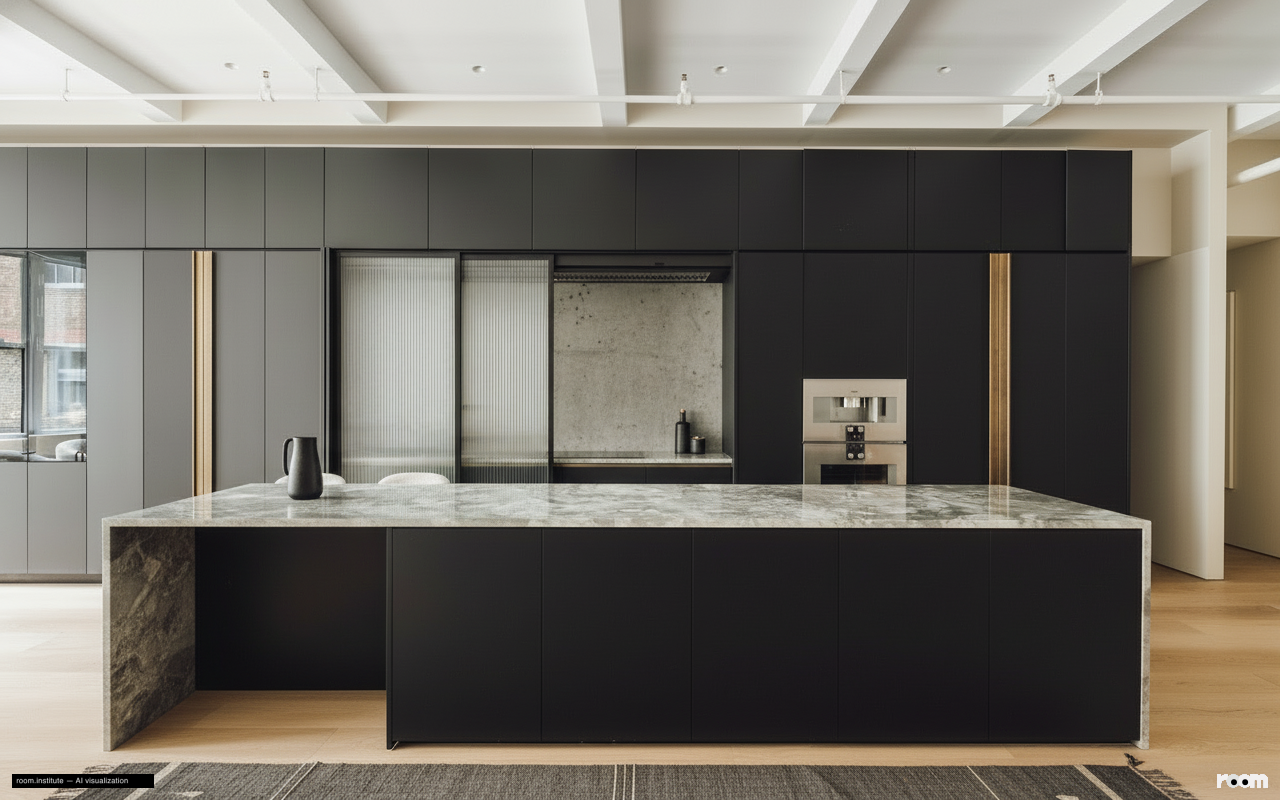
Existing dark cabinetry transforms into deep charcoal matte lacquer. This forms a dense, monolithic backdrop. A custom raw concrete panel installs behind the main cooking alcove. A sliding fluted translucent glass screen partially obscures this raw texture.
The island countertop changes to honed limestone with a waterfall edge. Patinated brass pantry units integrate into the charcoal cabinetry. These units reveal warm walnut interiors when opened. A recessed linear LED strip lights the ceiling beams, reducing visual clutter.
This room makes friction a visible, functional element.
Design Philosophy
Material-led design guides every surface choice in this space. Finishes are selected for their inherent qualities and physical presence. Tactile contrast creates essential friction between distinct elements. This approach highlights the unadorned beauty of each material interaction.
Spatial Narrative
The eye first draws to the deep charcoal wall and its partially obscured concrete panel. You move toward the island, touching the cool limestone surface. Seating at the island places you directly within this material dialogue.
Light Study
Morning light enters from a side window, casting soft shadows across the honed limestone island. Evening brings focused, linear light from the ceiling, emphasizing the structural beams. This strip provides direct task lighting without glare.
Living Vignette
Someone pulls open a brass pantry door, revealing warm walnut interiors and stored ingredients. They slide the fluted glass screen to access a specific cooking tool.
Material Palette
Deep charcoal matte lacquer: This finish feels smooth and absorbs ambient light, maintaining a consistent, deep tone over time.
Honed limestone: The surface feels cool and subtly textured, developing a rich, soft patina with use.
Raw concrete: This panel offers a rough, industrial texture, revealing natural variations that strengthen with age.