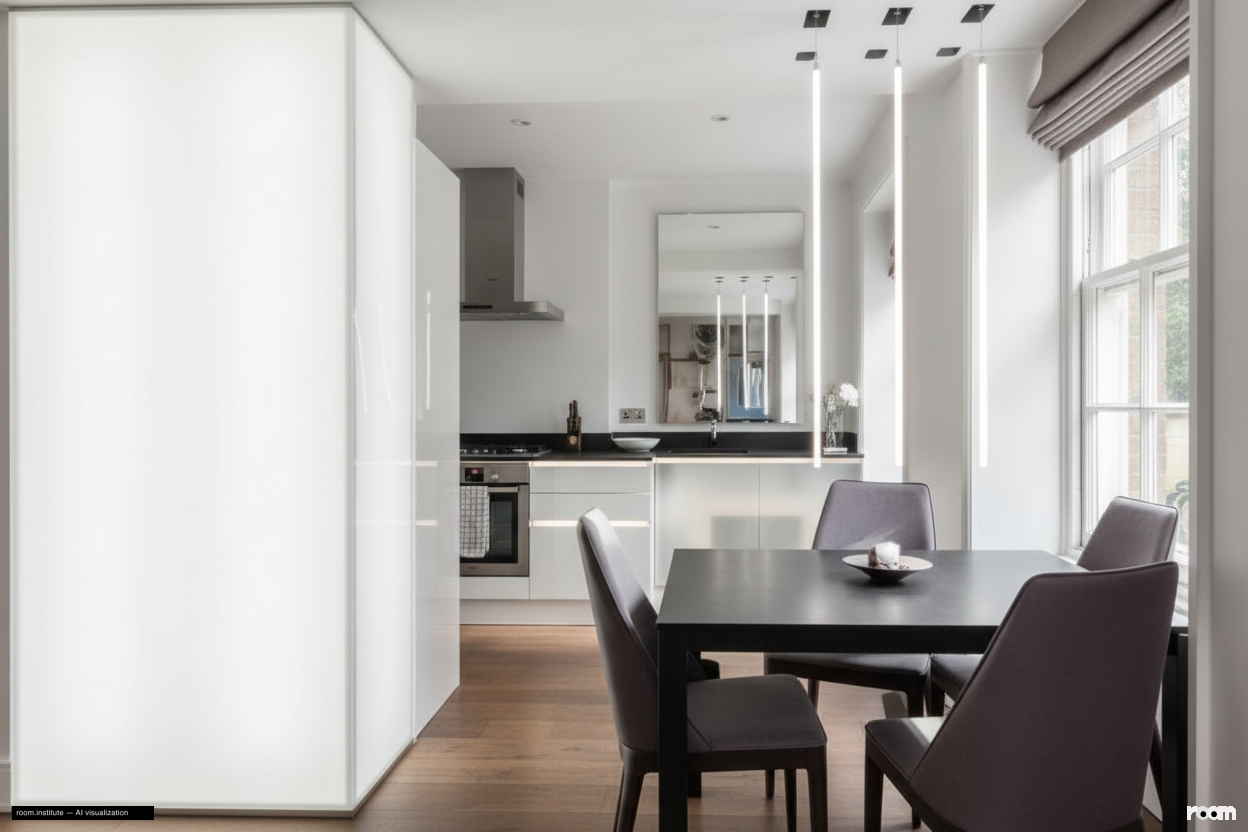
A translucent resin panel replaces a solid wall section. Internal lighting makes this panel a primary glowing boundary. Concealed linear LED strips define cabinetry edges with glowing architectural lines. Polished metal covers the backsplash, reflecting ambient and directed light. The dining table features a subtly glowing, translucent base.
Overhead spotlights project distinct light columns onto the dining surface. These focused beams define activity zones. Subtly brighter light patterns mark circulation paths on the floor. The space constantly shifts its perceived form through deliberate light manipulation.
Light constructs and deconstructs every surface.
Design Philosophy
This design uses light as the primary architectural material. It applies Light Architecture to dissolve static boundaries. The space becomes permeable, inviting continuous visual discovery. Ephemeral Design principles guide the constant shifting of perceived form.
Spatial Narrative
Your eye moves first to the glowing translucent wall panel. You follow slightly brighter light patterns projected onto the floor, guiding movement. You sit at the dining table, centered under distinct columns of light.
Light Study
In the morning, the internally lit wall panel provides a soft, diffused glow that complements any incoming natural light. Evening light shifts entirely, with precision spotlights creating focused beams and shadows. Concealed cabinet lighting offers a consistent, architectural line of ambient illumination.
Living Vignette
A hand reaches for a glass, momentarily highlighted by a direct beam from above. A book lies open on the dining table, its pages softly illuminated by the glowing base below.
Material Palette
Translucent resin panels: These feel smooth, diffuse light evenly, and age subtly without yellowing.
Polished stainless steel: This feels cool, reflects sharply, and resists wear or corrosion over time.
Frosted acrylic: This feels smooth, diffuses internal light softly, and maintains clarity with care.